
Augmented reality (AR) has quickly moved from a novelty to an essential part of retail. According to Grand View Research, the global augmented reality in retail market was valued at 7.84 billion dollars in 2024 and is projected to reach 105.87 billion dollars by 2033, as retailers lean into AR experiences from virtual try-on to AI-driven personalization. In grocery, AR is already changing how people shop, whether it’s guiding in-aisle navigation or enabling more personalized product discovery. Below, we’ll look at some of the ways augmented reality grocery store experiences use AR technology to improve the customer experience.
What Is AR and Why It Matters in Retail
Before diving into the specifics of how AR is being used in grocery stores, let’s discuss what AR is and how it works. As we’ve previously detailed, augmented reality (AR) is a technology that adds digital layers to the physical world: think 3D images, animations, or additional information about an object. This layer can be seen through a device such as a camera-equipped smartphone or tablet.
Some people confuse augmented reality with virtual reality, but there are several significant differences. VR creates a fully digital and immersive 3D environment. AR, on the other hand, keeps you in the real world by overlaying digital content onto what you’re already seeing, so shoppers stay grounded in the aisle while still getting extra context and guidance. And unlike VR, which requires expensive, specialized headsets and other equipment, AR can be accessed with a simple iOS or Android app without additional hardware.
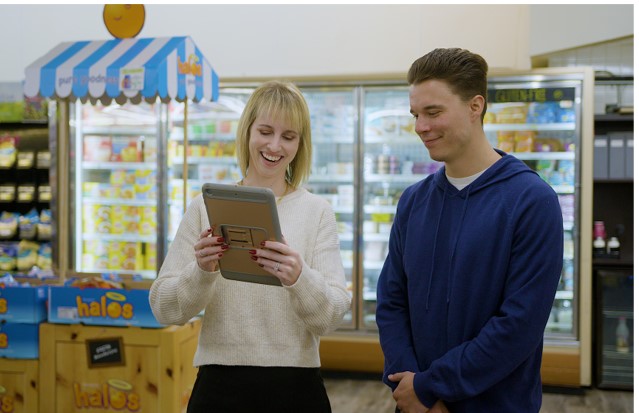
In a grocery store setting, shoppers pull out their phone camera in-store to engage with an AR experience. It’s essentially the next level of Snapchat filters, with more-advanced technology and features that can be customized to meet the needs of any store, making it a practical way for retailers to add guidance and personalization without rebuilding the physical environment.
Augmented Reality Grocery Store Experiences You Should Try in 2026
As AR becomes increasingly accessible to the public, grocery stores are beginning to take advantage of it. Here are some augmented reality experiences these retailers should implement, or at least test, in 2026:
Personalized shopping experience
Grocery shoppers today expect retailers to recognize their preferences and needs. Recent results from AI-powered recommendation programs show that grocers using personalized suggestions can see revenue uplifts of up to 40 percent and roughly 35 percent basket growth. AR gives stores a way to turn those same data-driven recommendations into something shoppers can see in front of the shelf, with an app acting as a digital concierge that highlights relevant items and tailored offers as they move through the store.
For instance, many people have dietary restrictions, from lactose intolerance to celiac disease. An AR experience layered on top of loyalty and preference data can call out products that fit those needs, as well as flag potential allergens and surface better-for-you options right on the shopper’s screen. This reduces the time it takes customers to find suitable products and gives them greater confidence that what they’re choosing aligns with their health goals.
Wayfinding
Finding your way through a busy grocery store can be frustrating, especially when you’re short on time. When navigation apps first added AR overlays, they showed how helpful it can be to follow digital arrows instead of a flat map. The same idea now applies in grocery, where AR wayfinding helps take the guesswork out of moving through the store.
Instead of relying on static aisle signs or paper lists, shoppers can use an app that overlays simple on-screen prompts to show where to turn and when they’ve reached the right section. In practice, a shopper can search for an item in the app and follow clear directions on their phone, rather than wandering the store or stopping to ask for help. For retailers that want to go a step further, the same experience can be tied to a full basket, creating a route that moves logically through the store instead of sending shoppers back and forth.
Product recommendations
Another key personalization feature AR can provide for grocery stores is product recommendations. Ever wonder why companies like Amazon and Apple are so good at suggesting items you might like? The answer is data. Using the data from customer purchase history and preferences, AR apps can personalize the shopping experience by suggesting products that might interest each shopper.
For example, an app could suggest organic foods to health-conscious customers or recommend meat alternatives for vegan shoppers. With the help of AI and machine learning, AR apps can learn from customer preferences and behaviors to deliver products that will interest each user, then surface those recommendations visually when a shopper points their phone at a shelf or product display.
These recommendations can also be used for upselling and cross-selling opportunities. Using well-known recipes as inspiration, the app can suggest combination products that make cooking easier, such as the necessary ingredients for pasta Alfredo to someone who frequently purchases fettuccine.
Interactive product packaging
Only so much text can fit comfortably onto a label, but with interactive product packaging, AR can give the shopper an easy and immersive way to learn more about a product. By using their phone’s camera, shoppers can scan a barcode and unlock interactive content related to the item in question. That could include recipes, nutritional information, promotional videos, and customer reviews.
Herbal Essences bio:renew offered a strong example through their “Waves of Change” campaign. Shoppers scan bottles made from 25% beach plastic to access an AR beachfront experience with sustainability videos and an interactive game where they swipe to clean virtual plastic waste. When you scan the bottle with your smartphone camera, it brings their eco-story to life in a way that static labels never could.
Coupon displays
Nearly 93 percent of Americans use coupons or have used one in the last year, with digital coupons generating over 10.6 billion dollars in revenue annually, according to Capital One Shopping Research. Value-conscious shoppers still look for the best deals, but printed coupons often get lost or overlooked. AR offers a smarter way to surface those savings right where decisions happen.
Instead of generic app notifications, shoppers simply point their phone at a product or shelf, and AR overlays a floating discount badge or offer directly onto what they’re seeing. This makes promotions feel immediate and relevant to the moment. The AR layer grabs attention in a way static signage can’t, while also cutting stores’ costs on physical printing.
Digital try-on
An increasing number of grocery retailers are upgrading their offerings to include nonfood items. Virtual try-on technology can give shoppers a better understanding of what clothing or makeup will look like on them before they buy. Walmart and Target have led the charge in this area, but it’s becoming commonplace in more shops and on e-commerce platforms. Research shows virtual try-on solutions can boost sales by up to 30 percent and cut returns by 20 percent, making it a smart way for grocers to build confidence around these categories.
This practice helps to reduce returns due to poor fit or wrong colors. It also reduces the time spent trying things on and makes it easier for shoppers to compare different items visually.
Learn more about AR and VR in retail
Augmented reality grocery store experiences are becoming an increasingly important tool for retailers as shoppers expect more guidance and personalization during every trip. Grocers can start experimenting with AR in areas like wayfinding and product discovery to understand what genuinely resonates with their customers.
If you’re interested in exploring what AR could look like in your stores, reach out. Our virtual store solutions like SMX GO help sales teams visualize and validate AR displays and planograms directly in physical stores, so retailers can see exactly how concepts will fit and perform before approving execution.
Contact us today to learn more about how we can help your team turn AR from a buzzword into a practical advantage in grocery.
FAQ: AR in Grocery Shopping
How does AR improve the grocery shopping experience?
AR enhances the grocery shopping experience by overlaying helpful information directly onto products and store layouts. Shoppers point their phone at shelves to see personalized recommendations, pricing details, or guidance for new products, making in-person trips faster and more intuitive.
Can AR help with a shopping list in a physical store?
Yes, AR functionality works well with a shopping list during in-person grocery shopping. The app can read your list and overlay turn-by-turn directions on store layouts, so you move efficiently without backtracking or searching for out-of-stock items.
Does AR work for both in-person and online grocery shopping?
AR shines most for in-person grocery shopping, where it bridges the gap between physical shelves and digital convenience. For online grocery shopping, QR codes on product pages can launch AR previews of store layouts or new products before you order.
How can grocers use AR for marketing campaigns?
Grocers use AR in marketing campaigns to highlight pricing, promote new products, or address out-of-stock situations dynamically. Shoppers scan QR codes or point at displays to unlock interactive promotions tied to real-time store layouts and inventory.
What if a product is out of stock—can AR help?
AR functionality spots out-of-stock items instantly and suggests alternatives based on your shopping list or preferences. During in-person grocery shopping, it overlays nearby substitutes with pricing and availability right on your screen.